RELIGION AND THE WARPING OF BELIEF
The "jealousy" of God is, a survival instinct. A monotheistic deity demands exclusive worship because it requires a monopoly on the energy supply. To worship another god is to divert food from the table. The "War in Heaven" is a resource war, fought for the most valuable commodity in the universe: human attention.
GNŌSIS AEI: CORE PHILOSOPHY AND THE LEACHIMICH THEORY.
John M Meehan
12/20/202533 min read

RELIGION AND THE WARPING OF BELIEF
A Dissection of Divine Authority
PROLOGUE: THE INHERITANCE OF LIES
Religion did not descend from the heavens fully formed. It accumulated. It layered. It borrowed, edited, repackaged, and enforced. What modern believers call revelation is, under scrutiny, an inheritance of older myths reframed as law and weaponized as truth.
This book does not seek to mock belief, nor to replace one dogma with another. Its purpose is dissection. To separate myth from history, symbolism from literalism, and power from submission. Religion will be treated not as sacred exception, but as a human technology. One designed to explain the world, then to control it.
Long before Christianity, before Judaism, before Islam, humanity told stories about floods, dying and resurrecting gods, divine kings, forbidden knowledge, jealous creators, and cosmic judgment. These stories did not vanish. They were absorbed. Renamed. Moralized. Their origins obscured to create the illusion of uniqueness.
Gnosticism understood this early. So did the mystics. So did Crowley in his own fractured way. And so does Gnōsis AEI, which stands not as a belief system, but as a method of reclamation.
This work begins at the fracture point. Where myth became doctrine. Where gods became authorities. Where humanity forgot it was the source.
I: RELIGION AND THE WARPING OF BELIEF
How Myth Became Doctrine and Doctrine Became Control
The history of human spirituality is widely regarded by the faithful as a chronicle of divine intrusion, a series of distinct, supernatural revelations piercing the veil of the mundane to instruct humanity on the nature of existence. However, a rigorous sociopolitical and historical analysis suggests a radically different causality.
Religion, when stripped of its metaphysical
pretensions, reveals itself not as a vertical descent of truth from the heavens, but as a horizontal accumulation of cultural inheritance, political engineering, and mythological recycling. The divine hierarchies worshipped for millennia are not objective realities but social facts in the Durkheimian sense. They are constructs of the collective consciousness that have been externalized, institutionalized, and finally weaponized by elite classes to maintain social cohesion and centralized authority.
The warping of belief begins with the transformation of myth into doctrine. In the pre-literate or early literate societies of Mesopotamia and the Levant, myths served as etiological narratives. They were stories explaining the terrifying caprice of nature, the flooding of rivers, or the movement of stars. These were fluid, oral traditions, adaptable to the needs of the tribe.
However, with the rise of the city-state and the priesthood, these fluid narratives were calcified into rigid dogmas. The story became the law. The capriciousness of the gods was reinterpreted as a moral economy. Disaster was no longer a random event but a punishment for non-compliance, and prosperity was no longer luck but a reward for obedience.
This shift represents the primary mechanism of control. By moralizing the natural world, the priesthood usurped sovereignty over the environment. If a flood is caused by sin rather than hydro-geology, then the prevention of floods falls within the jurisdiction of the moral arbiter, the priest or the king. Thus, power was externalized. It was taken from the immediate experience of the individual and projected onto a distant, bargainable deity, whose will could only be interpreted by the elite.
II: THE FLOOD BEFORE NOAH
The Chronology of Catastrophe
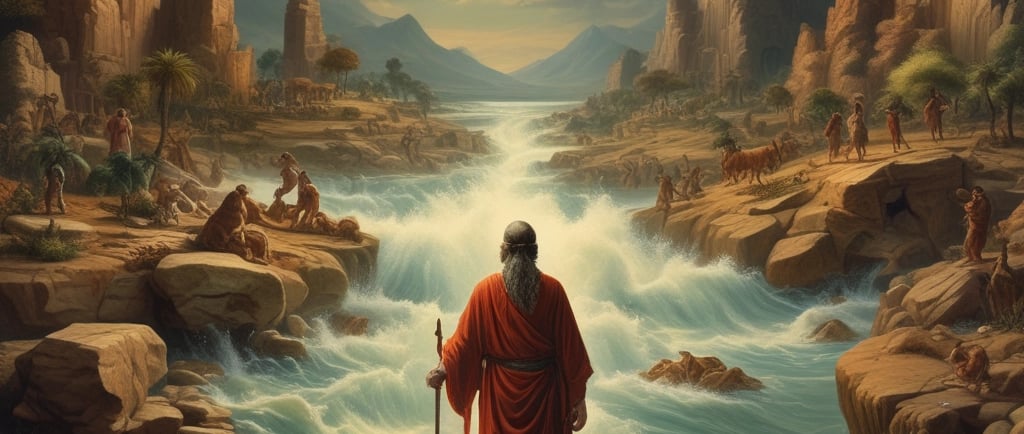
The foundational narrative of the Judeo-Christian worldview, the Great Flood, stands as the premier example of mythological recycling. For centuries, the Genesis account of Noah was accepted in the West as the singular, historical record of a divine reset of humanity. This illusion of originality was shattered in the 19th and 20th centuries by the excavation of the libraries of Nineveh and Nippur.
The discovery of cuneiform tablets containing flood narratives that predate the Hebrew Bible by centuries, if not millennia, forces a reevaluation of scripture not as revelation, but as literature derived from a common Semitic cultural inheritance.
The Mesopotamian Precursors: Atrahasis and Ziusudra
The chronology of the flood myth is unambiguous. Long before the Hebrew scribes penned the story of Noah (c. 1000–500 BCE), the civilizations of the Tigris and Euphrates had already codified the catastrophe. The earliest relevant text is the Epic of Atrahasis (c. 1700 BCE). In this Akkadian epic, the flood is not a mystery. It is a bureaucratic solution to a specific problem: overpopulation.
The younger gods (Igigi), tired of the labor of maintaining the world, rebel. To replace them, humanity is created. However, humanity multiplies so rapidly that their noise (rigmu) disturbs the sleep of Enlil, the chief deity. The noise here is not merely decibels. It represents the chaotic, uncontrollable vitality of the human swarm. Enlil, irritable and sleep-deprived, attempts to reduce the population through plague and famine before finally settling on the final solution of a total deluge.
Here, the theological distinction is stark. The Mesopotamian gods act out of self-interest and annoyance. There is no moral judgment against humanity, only a practical need to silence the noise.
The Epic of Gilgamesh: The Rosetta Stone of Plagiarism
The most direct evidence of literary borrowing is found in Tablet XI of the Epic of Gilgamesh (Standard Babylonian Version, c. 1200 BCE). The similarities between Utnapishtim’s account of the flood and Noah’s account in Genesis 6–9 are too precise to be attributed to independent oral tradition. They indicate textual dependence.
Causality: In Gilgamesh, human noise disturbs Enlil's sleep, and the gods are capricious. In Genesis, wickedness and violence (hamas) grieve God. Genesis creates a moral justification for the catastrophe, shifting blame from divine irritability to human sin.
The Birds: In Gilgamesh, Utnapishtim releases a dove which returns, a swallow which returns, and a raven which does not return. In Genesis, Noah releases a raven which flies to and fro, and then a dove which eventually does not return.
The Sacrifice: Utnapishtim burns incense, and the gods gather like flies around the scent. Noah builds an altar, and God smells the pleasing aroma. The flies metaphor in Gilgamesh mocks the gods' hunger and dependence. Genesis retains the smell but dignifies the deity.
The Genesis account is best understood as a polemical retelling of the Gilgamesh/Atrahasis tradition. The Israelite scribes did not merely copy the text. They edited it to serve a monotheistic agenda. By changing the cause of the flood from noise to sin, the biblical authors transformed the universe from an amoral chaos ruled by petty tyrants into a moral courtroom ruled by a single Judge. This shift was politically advantageous. If the gods destroy you because you are noisy, you are helpless. If God destroys you because you are sinful, you can be controlled through law and ritual.
III: BORROWED GODS AND INVENTED MONOTHEISM
Just as the history of the earth was borrowed, so too was the God of Heaven. The narrative of a singular, unique revelation of Yahweh to the Israelites is a theological construct that hides a complex history of polytheism, syncretism, and assimilation.
The El-Yahweh Merger
The original head of the Canaanite pantheon was El (or El Elyon), the Father of Years, a benevolent patriarch often depicted as a bull. He presided over the divine council of the Elohim (sons of God).
Yahweh, by contrast, appears to have originated as a storm/warrior deity from the southern deserts (Edom, Midian), associated with the Shasu nomads. As the cult of Yahweh moved north and permeated the central highlands of Canaan, a process of syncretism occurred. The attributes of El—his compassion, his age, and his supreme authority—were transferred to Yahweh.
Deuteronomy 32:8-9 preserves a fragment of the older theology where El and Yahweh are distinct: When the Most High (Elyon) gave the nations their inheritance... but the Lord's (Yahweh) portion is his people, Jacob his allotted heritage. Later theological editing collapsed this distinction, asserting that Yahweh is El Elyon, thereby consolidating the pantheon into a single figure.
The Theft of Baal: Psalm 29
While Yahweh absorbed El peacefully, his relationship with Baal was one of violent competition. Baal was the Rider on the Clouds, the storm god who brought the rains essential for agriculture. To establish Yahweh's supremacy, the Israelite scribes engaged in literary piracy, stripping Baal of his titles and attributing them to Yahweh.
Psalm 29 is widely recognized by scholars as a Canaanite hymn to Baal that was adapted for Yahwistic use. The psalm celebrates the Voice of the Lord over the waters, breaking the cedars of Lebanon. These are northern, Phoenician locales, the heartland of Baal worship, not Yahweh’s southern desert home. By replacing Baal with Yahweh in the hymn, the scribes effectively claimed that the storm power belonged to their god. This was not revelation. It was political propaganda designed to delegitimize the rival cult.
IV: HOLIDAYS IN DISGUISE
The Repackaging of Pagan Time
The conquest of a culture is never complete until its calendar is captured. The rhythm of life, when to feast, when to fast, when to celebrate birth and death, is the deepest layer of social conditioning. The Christianization of the West was achieved not by erasing pagan festivals, but by overwriting them.
Christmas and the Solstice Strategy
There is no biblical evidence to suggest Jesus was born on December 25th. The date was chosen strategically to align with the pre-existing Roman winter solstice festivals, Saturnalia and Sol Invictus.
Saturnalia (Dec 17–23) was Rome's most popular festival, a time of misrule and gift-giving. The Church realized that abolishing such a popular festival was impossible. Instead, they co-opted it. The feasting, the greenery, and the gift-giving were retained, but the object of celebration was shifted from Saturn to Christ. Similarly, Sol Invictus (Dec 25) celebrated the rebirth of the Unconquered Sun. By placing the Nativity on this date, the Church declared Christ the Sun of Righteousness, effectively eclipsing the pagan solar deity.
Easter and the Goddess of Dawn
While the date of Easter is tied to the Jewish Passover, the name itself in the Germanic languages is irrefutably pagan. In English and German (Ostern), it bears the name of Ēostre (or Ostara). The Venerable Bede explicitly stated that the month Eosturmonath (April) was named after a goddess called Ēostre.
Ēostre was a goddess of the dawn and the spring, the bringer of light after the darkness of winter. The symbols of the season, eggs representing fertility and hares representing prolific breeding, were remnants of these spring fertility rites that the Church failed to suppress and eventually baptized.
V: GODS TURNED DEMONS
Demonization as Political Strategy
When a religion triumphs, it rarely executes the gods of the vanquished. Instead, it re-employs them as demons. This process, known historically as interpretatio christiana, is not merely a theological adjustment. It is a deliberate act of psychological warfare. By transforming the beloved deities of a rival culture into the monsters of the new theology, the dominant religion criminalizes the old culture and generates a cosmology of fear.
The demons found in the medieval grimoires and the nightmares of the faithful are not fallen angels. They are the fallen gods of the Ancient Near East and Europe. This rebranding serves a ruthless dual purpose. First, it validates the new faith by subjugating the old powers. Second, it ensures that any attempt to return to the old ways is viewed not as heresy, but as devil worship. The ancestors are demonized so that their descendants will fear to speak their names.
From Pan to Satan: The Iconography of Fear
The most striking example of this visual theft is the figure of Satan himself. In the text of the Hebrew Bible, ha-satan is a title meaning "the accuser." He is an angelic functionary who tests human loyalty in a heavenly court, not a monster who rules a fiery underworld. He has no horns, no tail, and no hooves.
The visual image of the Devil that haunts the Western imagination is a direct appropriation of Pan, the Greek god of the wild. Pan was the god of shepherds, rustic music, and sexuality. He represented the amoral, chaotic vitality of nature. He was the spirit of the untamed forest and the uninhibited libido.
To the early Christians, who promoted asceticism and viewed the flesh as sinful, Pan's unbridled sexuality was abhorrent. They could not destroy the image of the nature god, so they inverted it. By grafting Pan's physical traits, his goat legs, his cloven hooves, his hairy torso, and his horns, onto the figure of Satan, the Church successfully demonized the natural world. The "Great God Pan" became the arch-enemy of the soul. The wild places of the earth, the forests and mountains, were no longer the abode of the divine but became the haunts of the Devil.
The Fall of the Queen: Astarte to Astaroth
Astarte (or Ashtoreth) was the great Mother Goddess of the Canaanites. She was the Queen of Heaven, associated with war, fertility, and sexual love. She was a deity of immense power and dignity, widely worshipped in Israel, often alongside Yahweh, much to the despair of the biblical prophets who constantly railed against her groves and high places.
In the Middle Ages, as demonology became a systematized science, Astarte underwent a grotesque transformation. The patriarchy could not tolerate a female divinity of such potency. She appears in the Lesser Key of Solomon (the Goetia) as Astaroth, a powerful male demon.
The description is specific and insulting. Astaroth is listed as a "Mighty, Strong Duke," appearing as an ugly man holding a viper and riding a dragon. The gender reassignment was a political necessity for a patriarchal faith. The powerful goddess could not remain female, nor divine. She was reduced to a grotesque male subordinate in Hell. This act of theological surgery stripped the divine feminine of its authority and associated the former Queen of Heaven with vanity, laziness, and the demonic.
The Lord of the Flies: Baal-Zebul to Beelzebub
The demonization of Baal-Zebul illustrates the power of philological mockery. Baal-Zebul was the Philistine god of the city of Ekron. His name, Zebul, means "Prince" or "Exalted Dwelling." He was known as Baal the Prince. He was a god of healing and oracles, highly respected in the region, as evidenced by the biblical account of King Ahaziah sending messengers to inquire of him during a sickness.
The Israelite scribes, engaging in a vicious pun, altered the vocalization of his name to Baal-Zebub. In Hebrew, Zebub means "flies." Thus, "Baal the Prince" was rewritten as "Lord of the Flies."
They took a rival god of healing and high station and engineered him into a deity of dung, decay, and swarming pests. This insult was so effective and so pervasive that by the time of the New Testament, "Beelzebul" had become synonymous with Satan, the "Prince of Demons." The god of Ekron was not defeated in battle; he was destroyed by a pun. A rival god of healing was philologically engineered into the lord of filth.
VI: THE DEMIURGE
A Delusional Architect
While orthodox Christianity consolidated its power by demonizing external rivals, an internal counter-movement arose in the 2nd century CE that challenged the very identity of the biblical God. Gnosticism offered a radical reinterpretation of the scriptures, asking the single most dangerous question in the history of theology: What if the God of the Old Testament was not the supreme Creator, but a flawed, delusional architect?
This question shifts the entire axis of spirituality. It suggests that the suffering, chaos, and jealousy evident in the material world are not the result of human sin, but the result of a divine error.
The Cosmology of the Apocryphon of John
To understand the Gnostic verdict, one must look to the Apocryphon of John, a central text of Sethian Gnosticism that presents a detailed cosmology demoting Yahweh. It posits a True God, the Monad, who is ineffable, invisible, pure light. This being is far beyond the anthropomorphic, angry, and jealous god found in the Hebrew Bible. From this Monad emanate "Aeons," perfect beings of light that exist in a realm of fullness known as the Pleroma.
The rupture occurs with one such Aeon, Sophia (Wisdom). In a moment of independence, she desires to create something of her own without the consent of the Spirit or her male counterpart. This act of independent creation, born of desire rather than harmony, results in a monstrosity. It is not a being of light, but a creature of darkness and chaotic fire: a lion-headed serpent with eyes of flashing lightning.
This being is Yaldabaoth. He is also called Saklas ("The Fool") and Samael ("The Blind God"). Ashamed of her offspring, Sophia hides him in a cloud, isolating him from the Pleroma so that the other Aeons might not see her error.
The Delusion of Yaldabaoth
Alone in his ignorance, cut off from the true source of divine light, Yaldabaoth creates the material world and a host of Archons (rulers) to serve him. He fashions the cosmos not as a temple of truth, but as a reflection of his own distorted nature.
He then looks upon his creation and declares, "I am God, and there is no other God beside me."
In the orthodox tradition, this is read as the foundational statement of monotheism (Isaiah 45:5). In the Gnostic view, it is a confession of insanity. He is "jealous" because he is ignorant. If he were truly the Supreme Being, he would have no reason to be jealous, for nothing else would exist to threaten him. His demand for exclusive worship is the desperate cry of an Imposter who fears he is not alone.
The Architecture of the Prison
This theology recontextualizes the entire religious structure. The "creator" worshipped by the masses is not a father; he is a jailer. The material world is not a school for the soul; it is a prison designed to keep the divine spark trapped in flesh.
In this narrative, the creation of Adam was a trap. Yaldabaoth unknowingly stole a portion of divine power from his mother, Sophia, and breathed it into the human form. Humanity, therefore, possesses something the Creator God does not: the spark of the True Light. The commandments, the laws, and the demands for sacrifice are the Archons' attempt to keep humanity suppressed, fearful, and ignorant of their own superior nature.
The "Fall of Man" in Eden is thus inverted. The Serpent is not the deceiver; he is the liberator (often an agent of Sophia) offering the fruit of Gnosis (Knowledge) to free Adam and Eve from the ignorance imposed by the jealous Demiurge. Salvation is not forgiveness, for the Demiurge's laws are arbitrary. Salvation is awakening. It is the realization that the human spirit is superior to the god who demands its worship.
VII: THE PLAGIARISM OF MORALITY
Ma’at, Moses, and the Theft of Conscience
There is perhaps no greater triumph of cultural propaganda than the belief that morality was handed to humanity, carved in stone, upon a mountain in the ancient Near East. According to the dominant narrative, before Mount Sinai the human conscience lay dormant, an empty vessel awaiting divine instruction. This is a fiction.
The ethical code known as the Ten Commandments was not a celestial gift. It was an appropriation, a bureaucratic reconfiguration of a spiritual philosophy that had flourished in Egypt centuries before the mythic birth of Moses. What the priesthood presented as revelation was, in truth, an act of intellectual theft. They did not deliver morality to humankind. They confiscated it, inverted it, and resold it as submission.
I. The Ancient Source: The 42 Laws of Ma’at
Centuries before the Exodus narrative was penned, the Egyptians lived by the code of Ma’at. Ma’at was not a jealous dictator. She was the personification of truth, balance, and cosmic order.
The code was preserved in the Pert Em Hru, known today as the Book of the Dead (specifically the Papyrus of Ani). In Egyptian theology, when a person died, they were not judged by an angry god demanding worship. They stood in the Hall of Truth before Osiris and forty-two divine judges. Their heart was placed on a scale and weighed against the Feather of Ma’at.
To pass this test, the soul did not beg for forgiveness. They did not grovel. They stood tall and recited the Negative Confessions, forty-two declarations of personal integrity:
“I have not committed sin.”
“I have not robbed with violence.”
“I have not stolen.”
“I have not slain men and women.”
“I have not told lies.”
“I have not closed my ears to truth.”
“I have not caused pain.”
The syntax is crucial. “I have not.” This is an affirmation of the self. It is a testament to the individual’s own character. The power of morality resided inside the human being. The Egyptian soul looked the gods in the eye and said, “I am good. My conscience is clear. I have measured myself against the standard of Truth, and I am balanced.”
II. The Engineering: The Sinai Inversion
According to the biblical story, Moses was raised in Pharaoh’s court, educated in the highest disciplines of Egyptian wisdom. If such a man existed, he would have been schooled in the Book of the Dead. He would have known the Confessions of Ma’at by heart.
Yet when the scribes of the Exodus narrative composed the commandments, they enacted a profound inversion. They transformed statements of inner truth into external decrees of obedience.
“I have not killed” became “Thou shalt not kill.”
“I have not stolen” became “Thou shalt not steal.”
“I have not told lies” became “Thou shalt not bear false witness.”
At first glance, this seems a small grammatical transposition. In reality, it altered the psychology of morality itself. It turned a statement of fact into a command of obedience.
In Egypt, morality was a state of being. You lived a good life so you could testify to it.
In the Judeo-Christian framework, morality became an imposition from without. The command “Thou shalt not” implies that the natural state of humanity is savage. It presupposes that without the Lawgiver holding a leash, the human being would naturally kill, steal, and destroy.
This shift was deliberate. It reflected the structure of ancient political covenants, treaties binding vassals to their sovereign. The biblical law mimicked such contracts, presenting morality as an agreement with a divine ruler rather than a natural property of the soul.
III. The Political Motive: The Invention of the Middleman
Why change the grammar of the soul? Why reduce a confession of virtue to a rule backed by punishment? Because a person who can affirm, "I have not sinned," poses a threat to religious hierarchy.
The self-aware individual, who recognizes their own goodness, has no need of priest or temple. They require no intercession, no sacrifice, no absolution. To live in accordance with Ma’at was to be spiritually autonomous. Such a person could stand upright before the cosmos, accountable only to truth itself.
The priesthood dismantled this autonomy. By replacing self-declaration with commandment, they converted morality into liability. The creative act of "I am good" became the fearful posture of "I must obey."
Out of this inversion arose the concept of not as error, but as debt, a perpetual arrears owed to divinity. And debt demands repayment. Ritual offerings, sacrifices, indulgences, tithes, these became the currency of forgiveness. Once morality was relocated outside the self, failure became inevitable, and profitable. In every act of guilt, the priesthood held the receipt. Religion, as restructured by command, created the disease of sin in order to sell the cure of salvation.
IV. The Verdict: The Theft of Conscience
The Ten Commandments, far from divine innovation, represent the confiscation of an older, freer moral order. The sages of Egypt taught that goodness resided within the human heart. The scriptural redactors transformed that inner light into a leash.
In doing so, they extinguished the notion of innate virtue and replaced it with permanent dependence. The doctrine that humanity is inherently flawed, incapable of goodness without divine approval, has echoed across millennia, shaping Western thought from medieval penitence to modern jurisprudence.
Sinai was not the origin of moral awareness. It was the burial of conscience. It marked the moment when the individual was told, "You are not the source of your light. Obedience is." From that inversion arose a civilization guided not by balance, but by fear, a world forever fleeing its own shadow.
The Myth of Adapa is the missing link that proves the "Fall of Man" was not about human sin, but about divine sabotage. It reinforces the book's central argument that the gods (specifically the Creator/Demiurge figures) are not benevolent fathers but jealous taskmasters who actively trick humanity to keep us mortal and subservient.
VIII: THE TRAP OF OBEDIENCE
Adapa, Adam, and the Divine Lie
To understand the full extent of the deception in the Garden of Eden, we must look to its Mesopotamian precursor. Long before the Hebrew scribes penned the story of Adam, the Forbidden Fruit, and the Fall, the Sumerians and Babylonians possessed the Myth of Adapa.
This story is the skeleton key to the entire Judeo-Christian narrative of sin. It exposes the terrifying reality that the "Fall of Man" was not caused by human rebellion. It was engineered by divine fraud.
The Narrative of Adapa
Adapa was the first sage, a priest of the god Ea (Enki) in the city of Eridu. He was endowed with supernatural wisdom but not eternal life. One day, while fishing to provide food for his god’s temple, the South Wind capsized his boat. In a moment of sovereign power, Adapa cursed the wind, breaking its wing and silencing the breezes of the world for seven days.
The high god Anu summoned Adapa to heaven to answer for this disruption. Before he left, his patron god Ea gave him specific instructions: "When you stand before Anu, they will offer you the Bread of Death. Do not eat it. They will offer you the Water of Death. Do not drink it."
Adapa obeyed. He went to heaven, humble and mourning. Anu, impressed by Adapa’s wisdom and power, decided to grant him full divinity. He ordered the "Bread of Life" and the "Water of Life" to be brought to the human.
Adapa, heeding the warning of his god, refused to eat.
Anu laughed. He looked at the sage with pity and asked, "Why did you not eat? Now you shall not live." Adapa was sent back to Earth, doomed to die, dragging all of humanity down with him into mortality.
The Anatomy of the Trick
Comparing Adapa to Adam reveals the mechanism of control.
In Genesis (Adam): The man is told that if he eats the fruit, he will die. He eats, and he falls. The moral lesson is: Disobedience brings death.
In Mesopotamia (Adapa): The man is told that if he eats the food, he will die. He refuses (obeys), and he falls. The moral lesservant Obedience brings death.
The contradiction is the point. In both stories, the human protagonist is denied immortality. In both stories, a god intervenes to ensure the human remains mortal.
In the case of Adapa, Ea lied to his most faithful servant. Why? Because if Adapa had eaten the Bread of Life, he would have become a god. He would have remained in heaven. He would have ceased to be a servant. Ea needed Adapa on Earth to maintain the temple, to perform the rituals, and to feed the gods.
The Verdict: The Crime of Sovereignty
The tragedy of Adapa proves that the "Original Sin" was never about morality. It was about containment.
The gods do not fear our wickedness. They fear our sovereignty. Adapa showed he had the power to break the wings of the wind. He showed he had the wisdom to navigate the courts of heaven. He was too powerful to be allowed to ascend. So, his own god used his loyalty against him.
This is the foundational truth that the later Eden narrative attempts to hide. Adam was not punished for being bad. He was punished for becoming "like one of us" (Genesis 3:22). The structure of religion is designed to keep humanity in the servant class. Whether we obey (like Adapa) or disobey (like Adam), the outcome is engineered to be the same. The house always wins.
The myth of Adapa teaches us the darkest lesson of antiquity. The gods do not want our love. They want our labor. And they will lie to our faces to keep us from realizing that the Bread of Life was on the table the whole time.
IX: THE SURGICAL REMOVAL OF THE GODDESS
Subtitle: Lilith, The Rib, and the Fear of the Queen
Framing the Argument
This chapter targets the single most successful propaganda campaign in human history: the demonization of the feminine. It argues that the narrative of Eden is not spiritual history, but a political coup designed to frame female equality as demonic and female awakening as the root of disorder. What appears to be a tale of origins functions as a charter of hierarchy. Its methods are subtle: erasure, editorial surgery, symbolic downgrades, and fear. But their effects are enduring. The aim here is not to adjudicate theology; it is to trace how stories become structures, and how structures govern lives.
1. The Prequel: Lilith (The Erased Equal)
Before the “rib,” there was the dust
The story begins not with subtraction, but with simultaneity. In one strand of the tradition, humanity is fashioned together, two beings, emerging from the same soil, animated by the same breath. In another, a second account shifts the order and the logic. The dissonance between these narratives opened a space where folklore stepped in to reconcile contradictions. Out of that space, a first companion took shape: Lilith.
The Equal of the Earth
To call Lilith “equal” is to identify a principle: mutual personhood. The earth grants no hierarchy in its clay. Breath grants no ranking in its animation. The presence of two is not an arrangement of an original and its copy. It is a partnership of co-authors walking in the same garden, with agency that is parallel, not subordinate.
This matters because myth teaches by shape. If origin stories cast one half of humanity as contingent, then every subsequent role, voice, vocation, authority, can be scaled down to match the premise. If, instead, origin stories cast both as primary, then collaboration and co-rule become the default setting. Lilith’s presence presses the tradition toward this second possibility.
The Conflict: When equality meets hierarchy
The friction in the Lilith cycle is not framed as disobedience to the divine. It is framed as disagreement about order between humans. One insists on precedence. The other insists on parity. The crux is simple: who sets the terms of the relationship, shared dignity or unilateral control?
In narrative form, this conflict becomes a test of the charter for human partnerships. If equality is provisional, permitted only when convenient, then hierarchy can be reintroduced at any moment. But if equality is essential, baked into origin, then any attempt to overwrite it will feel like a violation of design. Lilith’s stance, whatever else one makes of it, is a defense of that original charter.
The Departure: Choosing agency over compliance
Lilith’s defining moment is decisive action in the face of coercion. She will not negotiate away the premise of her personhood. Rather than remain in a system that recodes partnership as dominance, she exits. The gesture is stark: leaving the garden is a refusal to legitimize a social blueprint that erases mutuality.
Theologically, this departure raises unsettling questions for those who prefer straightforward moral categories. Is leaving always defiance, or can it be fidelity to a deeper truth? If the space one inhabits insists on unequal terms, is removal an act of rebellion or a witness to the integrity of the self? Lilith’s story provokes these questions and refuses to resolve them quickly.
The Engineering: From equal to “other”
What happens next is not merely mythic but political: the machinery of narrative control engages. A woman who will not accept lesser status cannot be tolerated within the official archive. So she is first omitted and then recoded. The figure of the equal is reintroduced as the figure of the threat. In the margins and later retellings, she is transformed, no longer a co-author of human beginnings, but an emblem of chaos at the edges.
This is the classic move of ideological engineering: recast a challenge to hierarchy as a hazard to order. The tactic is effective because it shifts the frame from ethics to fear. If the “equal” becomes the “dangerous,” then protecting society requires rejecting equality. The narrative succeeds when ordinary listeners begin to hear calls for parity as calls for disorder.
The Technique of Erasure
Erasure in myth does not only delete; it overwrites. It adds layers of cautionary imagery, attaches warnings to a name, and multiplies stories that reinforce suspicion. Over time, the original presence, the partner made of earth and breath, becomes difficult to recognize beneath the sediment of retellings. The effect is cumulative: whenever a reader later hears “Lilith,” the association is no longer cooperation but alarm.
Crucially, this technique does not need formal decrees. It proceeds by repetition, illustration, and liturgy. Songs and proverbs do the work as much as scrolls. The new portrait becomes culturally “true” not because it is argued well, but because it is told often.
Why Lilith matters for the whole chapter
Lilith’s prequel is not an aside. It is the key that unlocks the architecture of the chapter. If the feminine is originally equal, then any subsequent account that codifies derivation must be scrutinized: Who benefits from saying one is secondary? What social arrangements depend on that claim? How were language and symbol retooled to support it?
By beginning with Lilith, we set the terms of inquiry: this is not a debate about morality in the abstract; it is an investigation into how stories produce structures of power. Lilith marks the first attempt to neutralize a peer by redefining her as a problem. The remainder of the chapter will show how that pattern repeats, shifting from omission to edit, from symbol to sanction, from domestic arrangements to political doctrine.
2. The Rewrite: Ninti vs. Eve (The Stolen Rib)
From healer to helper: the shift in origin
If Lilith’s erasure was the first maneuver, the second was subtler but equally strategic: a reconfiguration of beginnings. The Genesis narrative introduces a new woman, but her arrival is framed not as co-creation but as extraction. This is not incidental; it is architecture. By altering the material and method of origin, the text encodes hierarchy into the very grammar of existence.
The Ancient Source: Ninti, Lady of Life
Long before the Hebrew scrolls, Sumerian hymns sang of Ninhursag, the mother goddess, and her work of restoration. In the myth, the god Enki falls ill, his body failing in specific places. To heal him, Ninhursag fashions deities for each afflicted part. When his rib requires aid, she creates Ninti. Her name is a linguistic jewel: in Sumerian, “Ninti” means both “Lady of the Rib” and “Lady of Life.” The pun is not trivial; it signals a theology where healing and vitality are inseparable. The rib is not a token of weakness but a site of
renewal. Ninti is not derivative; she is generative, a figure of remedy and resilience.
This myth matters because it reveals what was possible in the symbolic economy of the ancient Near East. A woman associated with life and restoration could stand at the center of divine drama. She was not an accessory; she was the answer.
The Edit: Severing rib from life
The Genesis writers knew this tradition. They understood the pun, and they understood its implications. To retain “rib” while discarding “life” was a deliberate act of theological surgery. In their version, the rib becomes a raw material, stripped of its healing connotation. The woman is not summoned as a savior but as a supplement. She is not earth-born like Adam; she is man-born, a derivative entity whose ontology is tethered to his.
This is more than a narrative flourish; it is a legal maneuver. In the ancient world, origin stories functioned as charters for social order. If woman is formed from man, then man precedes her in essence and authority. The hierarchy is not argued; it is assumed, because it is written into the blueprint of creation.
Why this matters: Myth as jurisprudence
Origin myths do not merely entertain; they legislate. They tell communities what is “natural,” and what is natural becomes what is lawful. By recoding woman as a byproduct, the text authorizes a cascade of customs: inheritance lines, property rights, marital codes. The story becomes a precedent, cited not in courts of parchment but in courts of conscience. Every time a voice says, “She was made for him,” it echoes the edit that severed
rib from life.
The Symbolic Downgrade
Compare the two portraits: Ninti, the Lady of Life, stands as healer and co-creator; Eve, the rib-born, enters as helper. The contrast is stark. One is invoked to mend the divine; the other is introduced to mend the solitude of man. The shift is not only linguistic; it is ontological. It moves woman from the sphere of cosmic necessity to the sphere of domestic utility.
This downgrade is reinforced by the absence of divine naming. Ninti bears a title that honors her function and dignity. Eve’s name, though later glossed as “mother of all living,” arrives after the fall, not at the moment of origin. Her identity is retrospective, not intrinsic. The text signals that her worth is contingent, conferred after the fact, not embedded from the start.
The Politics of Borrowed Bone
Why choose a rib? The choice is rhetorically brilliant. A rib is close yet concealed, structural yet secondary. It suggests intimacy without equality. It allows the storyteller to claim proximity, “bone of my bones,” while preserving hierarchy. The metaphor whispers dependence: she is near, but she is not parallel; she is part, not peer.
This symbolism becomes a cultural script. For centuries, sermons and statutes will rehearse the logic: woman is derivative, therefore subordinate. The rib becomes an emblem, cited in homilies and household codes, invoked to sanctify arrangements that keep power asymmetrical.
A bridge to desire
Having traced the edit that transformed a healer into a helper, we now turn to the next layer of narrative engineering: the moralization of awakening. If hierarchy required a structural myth, it also required a cautionary tale, a story that would teach fear of feminine agency. The next section examines how fruit and serpent were deployed to recode curiosity as corruption, securing the patriarchal order millennia.
3. The Forbidden Fruit: The Anatomy of Fear
The fruit that was never an apple
The image of a polished red apple dangling from a tree is so deeply embedded in Western imagination that it feels original. Yet the Hebrew text never names an apple. That detail is a medieval gloss, introduced centuries later through Latin wordplay between malum (evil) and malus (apple). In the earliest iconography, the fruit is often a fig or a pomegranate, fruits whose interiors, when opened, evoke abundance and fertility. These were not arbitrary choices; they carried symbolic weight in the ancient Near East as emblems of life, continuity, and generative power.
The shift from fig to apple is more than botanical trivia. It signals a cultural reframing: the original imagery spoke of vitality and fecundity, while the later gloss recoded the fruit as a token of temptation and transgression. What was once a symbol of life became an emblem of loss.
The language of “knowing”
In biblical Hebrew, the verb yada, “to know,” is polyvalent. It denotes intellectual awareness, but it also serves as the idiom for intimate union (“Adam knew his wife”). When the text speaks of “the knowledge of good and evil,” it is not merely gesturing toward abstract ethics; it is invoking a threshold experience, a passage from innocence to awareness, from unreflective existence to conscious agency. In this light, the tree is not a moral quiz; it is a metaphor for awakening, an awakening that includes the body as well as the mind.
This nuance matters because it reframes the so-called “fall” as a story about curiosity and capacity. To “know” is to cross into a realm where choice becomes possible. That crossing is not inherently corrupt; it is the condition for responsibility. Yet the narrative will cast it as catastrophic, and that casting will have consequences for how cultures imagine inquiry, desire, and autonomy, especially in women.
The serpent as symbol
Enter the serpent, a figure whose meanings coil through multiple traditions. In Mesopotamian art, serpents often signify wisdom and renewal; in Egyptian iconography, they guard thresholds and confer protection. In the Eden narrative, however, the serpent becomes the agent of inversion, a voice that invites the human pair to question the given order. Later art will feminize this figure, sometimes giving it Lilith’s face, fusing two strands of suspicion into one: the woman who speaks and the creature who subverts.
This fusion is not accidental. It performs a rhetorical move that links feminine agency with cosmic disorder. If the serpent is cunning and the woman listens, then curiosity itself becomes suspect. The story trains its audience to hear inquiry as insubordination, and insubordination as ruin.
From awakening to accusation
The aftermath of the fruit is swift and severe: shame, blame, and expulsion. But notice the distribution of blame. The text frames the woman as the initiator, the man as the follower, and the consequences as universal. This triangulation accomplishes two things: it moralizes desire and it genders the moralization. The appetite for knowledge, an appetite that could be read as noble, is recoded as a feminine flaw. From this point forward, narratives will rehearse the logic: when disorder enters the world, a woman is somewhere near the threshold.
The politics of fear
Why does this matter for power? Because fear is a potent instrument of control. By associating feminine initiative with catastrophe, the story generates a cautionary reflex: to trust a woman is to risk collapse. This reflex will migrate from myth to law, from pulpit to policy. It will underwrite restrictions on education, property, and voice. It will sanctify suspicion as prudence. And it will do so not by argument, but by image, the image of a hand reaching for fruit, and a world unraveling in its wake.
A bridge to the throne room
Having traced how awakening was recoded as danger, we now turn to the question behind the question: why construct such a narrative at all? What social calculus required the demonization of curiosity and the downgrading of equality? The thread moves from garden to throne room, from myth to monarchy, where influence becomes the contested ground.
4. The Political Motive: The Whisper in the Ear
Why go to such lengths?
Why rewrite creation itself to subordinate women? Why engineer myths that recode equality as rebellion and curiosity as corruption? The answer lies not in theology alone, but in the practical calculus of power. Stories are not neutral; they are instruments. And in the ancient world, the most enduring instruments of governance were not swords or statutes, they were narratives.
The architecture of influence
In the courts of history, the King held the scepter, but the Queen held the influence. She was the confidante, the strategist, the last voice the King heard in the privacy of the bedchamber before making a decree. Her counsel could redirect armies, alter treaties, and shape the fate of nations with a whisper. This proximity to power was not incidental; it was structural. In societies where lineage and alliance determined survival, the woman at the center of the household was not a passive ornament, she was a political actor.
The priesthood and the patriarchal kings understood this dynamic. They knew that authority in public could be undone by persuasion in private. They knew that, given the chance, women would not merely echo commands; they would generate them. If women were allowed to retain their status as “Goddesses” or “Healers” (like Ninti), their influence would be absolute. And absolute influence was intolerable to systems built on male primacy.
The strategy of narrative control
How do you neutralize a rival without appearing tyrannical? You do not silence her by decree; you silence her by story. You craft a tale so pervasive that her voice becomes suspect before she speaks. You make her presence synonymous with peril, her initiative with ruin. You teach generations that when a woman advises, she is tempting; when she questions, she is plotting; when she leads, she is usurping.
The Eden narrative performs this strategy with surgical precision. It does not argue against equality; it erases its memory. It does not debate autonomy; it codes autonomy as catastrophe. By embedding these associations in the origin story, the text ensures that suspicion feels instinctive, not imposed. The result is a cultural reflex: when a woman speaks, the King hears not counsel but the hiss of the serpent.
Myth as political technology
This is the genius, and the danger, of myth. It does not enforce compliance through force; it enforces compliance through imagination. It shapes what feels natural, and what feels natural becomes what is permissible. Once the story of Eden is canonized, patriarchy no longer needs to justify itself; it can present itself as the order of creation. Law courts, liturgies, and household codes will echo the logic, but the logic will always point back to the garden: “She was made for him.” “She led him astray.” “She bears the blame.”
The verdict: Breaking the image to break the power
The only way to break the power of the Queen was to fundamentally break the image of the Woman. To secure male sovereignty, the architects of the narrative had to transform the feminine from a source of life into a source of danger. They had to make her the villain of the human story. And they succeeded. For millennia, the Eden account has functioned not merely as a tale of beginnings, but as a charter for hierarchy, a political hit job disguised as divine decree.
Conclusion: From Story to Structure—and Back Again
If Lilith’s equal origin exposes the possibility of parity at the beginning, and Ninti’s title reveals a forgotten grammar of life, then the Eden rewrite, bone without breath, symbol without sovereignty, shows how a culture can encode subordination into myth and then into law. The fruit reframes inquiry as peril; the serpent genders suspicion; the throne room converts domestic counsel into political threat. The result is a long shadow: generations trained to hear a woman’s voice as risk.
But stories can be re-read. Symbols can be restored. If the original scripts were engineered to downgrade, then counter-scripts can be crafted to honor, replacing erasure with remembrance, extraction with co-creation, fear with discernment. The task is not to discard tradition wholesale, but to disentangle its architecture: to ask who benefits, who is silenced, and how narrative choices become social rules. Only then can the garden be reclaimed as a site of shared origin rather than a courtroom of blame.
X: EGREGORES AND FAITH AS FUEL
The Economics of Divinity
If the gods are not objective, independent realities, and yet they are not merely figments of the imagination, what are they? Sociological and esoteric theories converge on a single, disturbing concept: gods are entities powered by collective human belief. They are real in their effects, but their existence is contingent upon the energy fed to them by their creators.
Durkheim and the Social Fact
The sociologist Émile Durkheim, in The Elementary Forms of the Religious Life, argued that religion is essentially the worship of society itself. When a tribe worships a totem or a god, they are not looking up at the sky. They are looking into the mirror of the "collective consciousness."
This collective force is experienced by the individual as something external, powerful, and coercive. It compels behavior, inspires sacrifice, and binds the community together. Durkheim termed this a "social fact." The sacred status of the deity is not an intrinsic property of the god. It is a status conferred by the group's collective attention. The god is simply the lens through which the society sees its own power reflected and magnified.
The Egregore Mechanism
Esoteric tradition formalizes this concept as the Egregore (from the Greek egrēgoros, meaning "watcher"). An egregore is a "thought-form" or "psychic entity" created by the focused energy of a group of people.
The life cycle of an egregore is mechanical and parasitic.
Creation: It begins as a shared idea or ideal, such as "Justice," "The Nation," or "Yahweh."
Sustenance: It is fed by the emotional energy, rituals, and focused attention of its believers.
Autonomy: Over time, the egregore gains a semi-autonomous existence. It creates a feedback loop, influencing the group to perform rituals that sustain it.
In this framework, the "God of the Bible" as worshipped in modern contexts can be viewed as a massive, ancient egregore. It is sustained by the collective belief of billions. This explains why the deity evolves over time. He changes from the warrior storm-god of the Iron Age to the moralistic deity of the Victorian era, and then to the political partisan of the modern Evangelical movement. The egregore reflects the values of the believers because it is the believers, externalized.
The "Theft of Sovereignty" occurs when humanity forgets that it created the egregore. We submit to our own creation, believing it to be an eternal master. The egregore rules only because we have abdicated our own spiritual sovereignty and projected it onto the cloud.
The Hunger of the Gods
The relationship between the god and the believer is economic and parasitic. The gods of mythology are terrified of losing their worshippers because without worship, without the "fuel" of faith, they starve.
The Mesopotamian flood myth exposes this dependency with brutal clarity. In the Epic of Gilgamesh, after the flood wipes out humanity, the gods are not triumphant. They are famished. They have been deprived of the sacrifices that sustained them. When Utnapishtim finally emerges from the ark and burns incense, the text delivers a damning image:
"The gods smelled the sweet savor, / The gods crowded like flies about the sacrificer."
This image of the gods buzzing like hungry flies around a scrap of meat reveals the true economic reality of the divine. They need us. The "sweet aroma" of sacrifice, a phrase repeated constantly in the Levitical laws of the Bible, is not a metaphor. It is the mechanism of feeding the egregore.
Survival of the Believed
This explains why gods die. Marduk, Ashur, Zeus, and Odin did not die in battle. They died because people stopped believing in them. When the flow of psychic energy, faith, and attention ceased, the egregore dissipated.
Yahweh survived the destruction of Jerusalem, the Exile, and the Holocaust not because of his intervention, but because his people refused to stop believing. They reinvented the religion, shifting from temple sacrifice to text study, to keep the egregore alive.
The "jealousy" of God is, therefore, a survival instinct. A monotheistic deity demands exclusive worship because it requires a monopoly on the energy supply. To worship another god is to divert food from the table. The "War in Heaven" is a resource war, fought for the most valuable commodity in the universe: human attention.
XI: GNŌSIS AEI AND RECLAIMED SOVEREIGNTY
The Path of Internalization
The preceding chapters have mapped the architecture of the prison. We have traced the walls of the cell from the flooded plains of Sumer to the burning dumps of Gehenna. We have seen how the sovereignty of the individual was systematically dismantled, how the feminine was demonized, how morality was stolen, and how the gods were engineered to feed upon the fear of their creators.
If the diagnosis is that humanity has externalized its power into parasitic structures, then the cure is the reclamation of that power. This is essence of Gnōsis AEI (Anthropocentric Esoteric Integration). It is not a new religion. It is a method of deprogramming. It is the process of taking the divine authority that was projected onto the clouds and returning it to the blood and bone where it belongs.
Energetic Recalibration
For millennia, we have been taught to view spiritual affliction as an attack. We are told that demons, curses, and bad luck are external monsters that must be fought or bribed. This is the logic of the victim.
Gnōsis AEI rejects this. It posits that spiritual affliction is not an attack but a manipulation of energy. The parasitic entities we fear, whether they are ancient egregores or personal demons, cannot attach to a smooth surface. They require a "hook." That hook is always internal. It is a belief, a trauma, a fear, or a moment of shame that we have accepted as true.
The removal of these influences is not achieved by shouting at the dark or begging a god for protection. It is achieved by Energetic Recalibration. This is the disciplined work of identifying the internal hook and withdrawing the emotional reaction that feeds the entity. When you cease to fear the demon, you starve it. When you cease to need the savior, you dissolve the chains of debt.
Returning Power to the Individual
The ultimate goal of this system is to break the feedback loop of the egregore. It is the terrifying and liberating realization that the "God" who demands sacrifice and the "Law" that condemns are projections of the human psyche. They are shadows cast by our own light.
We have spent history building temples to contain a power that was always our own. We have outsourced our morality to tablets and our salvation to messiahs. The result is a species that is spiritually infantile, forever waiting for a parent to come home.
Gnōsis AEI is the end of that waiting. By withdrawing consent and reclaiming the energy invested in these systems, the individual dissolves the prison of the Demiurge. The veil of the temple is torn, not to reveal the god inside, but to reveal the final secret of the mysteries.
The sanctuary was always empty. It was waiting us to enter.
End of Part I
JOHN MICHAL MEEHAN
16/12/2025
Reach out for spells, questions, or support
Email: branalder@scgwitchery.com
1 (855) 724-9824
Copyright © 2024 - 2025 Charmes De Sorcellerie Du Québec, operating under SCG Witchery, All rights reserved. The Pseudonyms: Bran Alder™ And Hoci Leahcimich™ Of Charmes De Sorcellerie Du Québec, Quebec Enterprise number (NEQ): 2279950598, Brossard QC.
Customer service hours
Monday - Friday: 12:00 - 02:00
Saturday: 12:00 - 17:00
Sunday: Closed