Muslim Magic: The True Origin Of The Griss Griss
Discover the true history of Muslim magic and the Griss Griss. Explore the Mande Islamic tradition, the role of Marabouts, and the power of Quranic amulets.
GNŌSIS AEI: CORE PHILOSOPHY AND THE LEACHIMICH THEORY.
Bran Alder
12/11/20254 min read
Muslim Magic: The True Origins of the Griss Griss
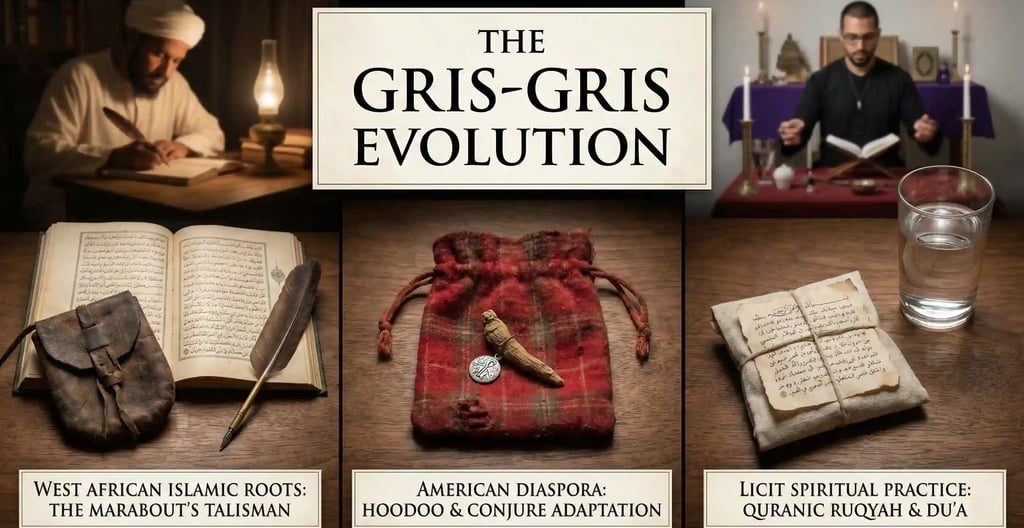
A gris-gris, also spelled grigri, is a talisman or amulet originating in the Muslim Mande communities of West Africa. The word is believed to mean “magic” in various Mande languages, marking the genesis of a unique form of Muslim magic that utilizes scripture for protection.
A gris-gris is typically a small cloth bag containing a ritual number of small objects, such as verses from the Quran, stones, herbs, or bits of bone. The talisman is believed to protect the wearer from evil, bring good luck, or, in some contexts, inflict misfortune on another person.
The practice was brought to the Americas through the transatlantic slave trade, where it became a significant element in Louisiana Voodoo, Haitian Vodou, and Hoodoo, where it is often referred to interchangeably with a mojo bag or conjure bag.
The True Roots of Muslim Magic: Beyond Simple Rootwork
The talisman is rooted in Islamic tradition. It holds a deep and complex history within the Muslim Mande communities of West Africa. The word itself, derived from Mande languages spoken by groups like the Mandinka and Bambara, is believed to mean "magic," indicating its original context as a potent tool of Muslim magic.
The Scholars of Mysticism: The practice centers around the power of the written word, particularly that of the Quran. Islamic scholars in West Africa, known as marabouts or karamokos, were and still are the primary creators of the gris-gris. They practice a mystical tradition known as Karamokobara, which has two paths: the path of prayer (seli) and the path of the amulet (siri). Those who follow siri become the experts in these talismans.
The Power of Scripture: The gris-gris is fundamentally an Islamic charm. It is a small cloth sack containing papers inscribed with Arabic scripture, usually verses from the Quran, or specific magical numerical squares called katemi. The power is located in the sanctity of the holy work written by the spiritually adept scholar, intended to prevent misfortune, cure illness, or forecast the future.
Distribution and Influence: The Mande speakers, particularly the Dyula people, were instrumental in spreading these Islamic charms across the Volta Basin. The wide respect for these marabouts, and the awe that the Arabic script commanded, made these Muslim amulet makers highly sought after even by non-Muslim courts, such as the Asante.
Translocation to the Americas: When enslaved Africans, including large numbers of Mande Muslims, were brought to the Americas, they brought the practice with them. The enslaved Muslims were often sought out for conjure work, as they possessed the knowledge to craft the protective gris-gris bags.
The Scholar and the Talisman: Marabouts and the Gris-Gris
To fully grasp the gris-gris in its original context, the profound spiritual authority of the Marabout must be appreciated. These scholars were the spiritual engineers, holding a monopoly on literacy in Arabic which was synonymous with power across the savannas of West Africa. The very act of writing transformed the material.
The Ritual of Writing: A marabout creating a Muslim amulet engages in a highly ritualized process. The writing must be precise, often done using special inks derived from charcoal and water, and sometimes incorporating specific plant material. The verse itself is carefully chosen based on the client's needs, a verse for protection is different than one for wealth.
The Inscription and Consumption: Sometimes, instead of sealing the inscribed paper into the leather or cloth pouch, the Marabout may wash the ink off the wooden slate or paper into a bowl. The client then drinks the sacred ink, believing the power and protection of the Quranic verse will be absorbed directly into the body.
The Container: The final object is often encased in leather, wrapped in meticulously stitched cloth, or even housed in small gourds, which are then worn on the body, sewn into clothing, or attached to objects. The materials themselves add protective layers, reinforcing the already potent scripture within, transforming the Mande gris-gris into an armored spiritual defense.
Understanding the marabout's dual role, both as a cleric and as a practitioner of siri, provides the necessary historical anchor for this West African tradition.
The Distinction: Licit Spiritual Work vs. Forbidden Siḥr
The practice sanctioned within the formal, mainstream Islamic tradition relies directly on the power of the Quran and the Divine Names, distinct from the forbidden practice of siḥr (sorcery) or divination (kihānah).
Ruqyah (Incantation or Exorcism)
This is the primary and universally accepted permissible form of spiritual defense and healing in Islam. A ruqyah is a recitation of specific verses and chapters from the Quran, such as Al-Fātiḥah, Āyat al-Kursī, and the last three chapters, along with authentic supplications (Duʿāʾ) from the Prophet Muhammad's traditions (Sunnah).
Purpose: It is used for healing physical and spiritual ailments, protection from the evil eye (al-ʿayn), defense against the mischief of the Jinn, and to counteract the effects of forbidden sorcery (siḥr).
Method: The reciter breathes or blows lightly onto the affected person or a liquid that the person will use or consume. The power is believed to derive only from the words of God and the complete reliance (tawakkul) on Him, without associating any partners (shirk).
Duʿāʾ (Supplication/Invocation)
The act of calling upon God for a specific need. When specific Divine Names or Attributes (al-Asmāʾ al-Ḥusná) are invoked for an outcome, this is viewed not as coercing the divine, but as leveraging a direct and personal relationship with the Divine through established channels.
Wird or Ḥizb (Litany/Devotional Practices)
In Sufi and other mystical traditions, there are powerful and lengthy collections of Quranic verses, prophetic supplications, and praises recited daily or during times of need. The practitioners believe it harnesses a profound spiritual energy (barakah) derived from the Divine Word itself.
Historically, in esoteric Islamic texts, these practices intersect with what scholars call the occult sciences (ʿUlūm al-Ghayb). Terms like Ilm al-Khawāṣṣ (the science of the unique properties of verses and Divine Names) describe this work, though the strict, mainstream view holds that the effects are simply granted by God.
The essential distinction is this: mainstream Islam condemns Siḥr because it involves seeking aid from forces other than God, while practices like Ruqyah are accepted precisely because they involve seeking aid only from God through His own revealed words. It is the intention and the source of power that determines the practice's legitimacy.
Reach out for spells, questions, or support
Email: branalder@scgwitchery.com
1 (855) 724-9824
Copyright © 2024 - 2025 Charmes De Sorcellerie Du Québec, operating under SCG Witchery, All rights reserved. The Pseudonyms: Bran Alder™ And Hoci Leahcimich™ Of Charmes De Sorcellerie Du Québec, Quebec Enterprise number (NEQ): 2279950598, Brossard QC.
Customer service hours
Monday - Friday: 12:00 - 02:00
Saturday: 12:00 - 17:00
Sunday: Closed